Cultivating a Life of Prayer
Explore practices and rhythms of prayer that invite deeper dependence on God, unity in the body of Christ, and sensitivity to the Holy Spirit.
Explore the Guide
Each practice offers a unique way to engage with God and serve His people through prayer.
Gatherings
Intentional Prayer
Prayer opportunities that arise in everyday moments, creating space for God to work.
Prayer Sets
Gathering with others around a specific topic or Scripture at the Lord's invitation.
Consecration
Pre-service prayer to prepare the atmosphere and align hearts with the Lord.
Extended Times of Prayer
Intentionally extended blocks of prayer, seeking God's presence and direction.
Commissioning Prayer
Prayer for those stepping into new roles or assignments.
Prayer & Fasting
Deliberate acts of humbling ourselves before God, seeking Him with greater focus.
Healing
Intentional Prayer
We all encounter opportunities to pray for others. Sometimes these opportunities arise before or after service on a weekend. Other times, we find ourselves praying over friends at dinner. Regardless of time or setting, this is often a defining moment where God is calling someone into deeper dependence on Him.
Approach every person with humility, compassion, and sensitivity. Remember that what's shared may be deeply personal—possibly the first time they've voiced this burden. Your role is to create a safe, Spirit-led space where they can encounter God's comfort and truth.
-
Step 1: Ask them how you can pray. Begin with a warm greeting and learn the person's name if you don't know it. Take a deep breath and set a calm pace. There's no need to rush. Normalize bold requests by asking something to the effect of, "What can we ask the Father for together?" This begins to shift the focus of the conversation from external symptoms to internal health. What is the root that needs to be addressed?
-
Step 2: Listen for what's really going on. Continue to ask clarifying questions to help identify the root. It's easy to get distracted by collateral damage and miss the true issue. Listen to the Holy Spirit as you converse. Is the Lord revealing anything that helps bring clarity? Is there unconfessed sin? Is this person a Christian or do they need to place their faith and trust in Jesus for the first time? Are they describing a symptom like anxiety that is actually being caused by a specific situation? It's okay if you don't get full clarity, but taking a little extra time to ask questions will often help focus your prayers.
-
Step 3: Choose a type of prayer and a posture. Choose the type of prayer and posture that best fits the situation. Simply placing your hand on their shoulder and interceding for them is often a great choice. But there are other options. You can ask them to kneel with you at the altar. You can have them open their palms and hold their hands out in a posture of receiving. Or maybe they need to pray before you do! For instance, if they're confessing a sin or insecurity, ask them to say that out loud to the Lord and then follow in prayer. If they're in need of healing, lay hands on them and consider inviting others to join.
-
Step 4: Bless them with Scripture & encouragement. You can bless them with Scripture both during and after your prayer. Memorizing Scripture is like rocket fuel for your prayer life. When you finish praying, consider sharing a verse, Bible story, or encouraging word with them. It's not uncommon that a specific passage will come to mind while you're praying. This creates a great opportunity to point them to that passage so they can reflect on it later. Before you finish, reflect back to them what you hear God saying or highlighting.
-
Step 5: Check-in to see how they're doing. After you've listened, prayed for, and blessed them… check-in. Ask them, "How are you feeling?" or "Do you feel any different?" Give them a moment to respond and process. Offer them a tissue. You've just engaged in hard Spiritual work together. That can be tiring! Make sure they feel seen and loved before moving on. And if there is clear follow-up that's needed, get their info or schedule a specific time to pray again or get them connected to the right person.
Our Goal:
To "bear one another's burdens" (Galatians 6:2) and walk in the power of agreement (Matthew 18:19–20), trusting that when we pray together in Jesus' name, He is present and working.
Prayer Sets
These times are designed to gather with others in prayer around a specific topic or portion of Scripture at the Lord's invitation. Together, we seek to respond to His leading, uniting our hearts in worship, intercession, and agreement.
- Identify the Focus: Clearly define the theme, topic, or Scripture passage that will guide the time of prayer.
- Facilitator Preparation / Roles: The facilitator should be prayerfully prepared to introduce the focus, share brief context, and guide the flow of the gathering. It can also be helpful to appoint other roles like Room Host, Worship Leader, and Greeter.
- Atmosphere of Worship: Plan for simple live worship or prepare a worship playlist that invites the room into reverence and expectancy.
- Visual Engagement: If possible, display the guiding Scriptures or key themes on a screen to help latecomers engage.
- Welcome and Orientation — Begin by introducing the theme and creating a posture of unity and expectancy.
- Facilitated Sharing — Invite participants to share brief insights, reflections, or burdens related to the topic or passage.
- Corporate Prayer — Lead the room in unified prayer around the central focus. Encourage freedom in expression while maintaining reverence and order.
- Small Group or Partner Prayer — Transition into smaller groups for more personal intercession and agreement.
- Individual Reflection and Prayer — Allow space for quiet, individual communion with the Lord.
- Closing Moment — End with gratitude, a corporate amen, or a short worship response.
Our Goal:
To draw us collectively into intercession around a shared focus—"They all joined together constantly in prayer" (Acts 1:14)—reflecting the unity, beauty, and power of the early church in prayer.
Consecration
Pre-service prayer is a dedicated time for intercessors to prepare the atmosphere before a service or gathering—to align hearts with the Lord, listen for His direction, and invite His presence to lead every aspect of the corporate time together. This time of prayer serves as both a personal and collective engagement with the Lord. Intercessors gather to dedicate the service or gathering to Him, to consecrate the space, and to seek His heart for what He desires to accomplish among His people. Intercessors are not praying for the event to go well—they are partnering with the Spirit to prepare the way for His presence and purposes. The goal is not to fill time, but to listen, discern, and agree with what heaven is saying over the gathering. Prayer during this time should cultivate spiritual alignment, peace, and readiness for what God desires to do in and through His people. Pre-service prayer is not about activity—it's about alignment. We pause before we lead so that every word, song, and moment flows from His presence.
In 2 Chronicles 20:1–30, King Jehoshaphat and the people of Judah are facing a massive enemy army. We see how God fought for them when they responded with prayer, fasting, worship instead of fear. When worshippers go out first, it's a profound act of spiritual alignment—one that shifts the unseen atmosphere before anything happens in the natural. Here's what happens in the spirit:
1. The atmosphere is claimed for the Lord
When worshippers go first, they are declaring, "This place, this moment, this battle belongs to the Lord." Worship becomes a weapon that establishes divine order. The focus turns from human strength to divine sovereignty. The atmosphere is cleansed, consecrated, and made ready for the move of God.
2. Heavenly alignment is activated
Worship releases agreement between heaven and earth. When worship goes first, heaven's rhythms begin to lead the way—angelic activity increases, spiritual resistance is pushed back, and the Lord's purposes advance unhindered. It's not just singing; it's setting alignment.
3. The people of God come under divine covering
It places the entire community under a canopy of God's presence. The covering of praise becomes a shield—confusion and fear lose their hold, and peace becomes the governing atmosphere. Psalm 22:3 says God is enthroned on the praises of His people—meaning His rule, authority, and peace begin to reign wherever praise is lifted.
4. Victory is declared before the battle
When worship goes first, it's a prophetic act—announcing victory before a single sword is raised. It says, "We trust the Lord to fight for us." Worship disarms the enemy because it refuses to engage on his terms. Instead of striving, it releases surrender—and surrender always ushers in divine strength.
5. Hearts are prepared and unified
Worship softens hearts, aligns motives, and brings unity to the people of God. Before any "battle," whether in ministry, prayer, or leadership, worship gathers everyone under one banner—the Lord's name. It's the sound of collective humility and shared faith, which invites God to dwell among His people in power.
Posture and Practice
- Gather in unity: Come together in reverence, humility, and expectation.
- Listen intentionally: Spend time in listening prayer, asking the Holy Spirit to reveal what He is inviting and highlighting for the corporate gathering.
- Pray Scripture: Declare God's Word over the time and space, standing in agreement with His promises.
- Bless the space: As available and appropriate, move through the physical location—praying, reading Scripture, and inviting the Lord's presence to dwell and move freely.
- Agree together: Conclude by uniting in prayer, aligning hearts and words with the Lord's purpose for the gathering.
Extended Times of Prayer
Extended times of prayer—whether 6, 12, or 24 hours—create space for our community to seek the Lord together in sustained worship and intercession. These times call us to deeper dependence, unity, and awareness of God's presence. Each hour offers a unique focus, guided by Scripture and the Spirit, as we partner with Heaven in prayer.
Begin by gathering a core leadership team to pray, plan, and discern the vision for the extended time. Each hour should have a clear theme or focus, allowing participants to engage intentionally throughout the duration.
Build a diverse team to cover the key areas of oversight and ministry:
- Facilitators: Provide direction, guide transitions, and maintain focus.
- Worship Leaders: Lead live worship or curate worship playlists to sustain a prayerful atmosphere.
- Creative Team: Design visual or artistic elements that foster reflection and engagement.
- Intercessors/Prayer Team: Cover the gathering in prayer and be available for personal ministry.
- Appoint Area Leads — Assign a lead for each key role (facilitation, worship, creative, intercession) to ensure clear leadership and communication.
- Select a Consecrated Space — Choose a quiet, sacred space that can remain open and prayerful throughout the duration.
- Create Interactive Prayer Stations — Set up creative, Scripture-based stations that invite participants to engage physically and spiritually in prayer.
- Provide Communion Elements — Make communion available for individuals or small groups to receive as part of their prayer time.
- Resource the Room — Supply Bibles, written liturgical prayers, and books or guides on prayer to support the time of prayer.
Our Goal:
To cultivate an unbroken rhythm of prayer and worship where individuals and groups encounter the living God, aligning our hearts with His purposes and echoing the devotion of the early church: "They all joined together constantly in prayer" (Acts 1:14). Joining in with the heart of Isaiah 62:6–7: "On your walls, O Jerusalem, I have set watchmen; all the day and all the night they shall never be silent. You who put the Lord in remembrance, take no rest, and give him no rest until he establishes Jerusalem and makes it a praise in the earth."
Commissioning Prayer
Commissioning Prayer is designed for individuals stepping into new territory or a new assignment. These times of prayer focus on honoring the person's "yes" before the Lord, cultivating fresh dependence on Him, and celebrating God's sending and purposes for their life.
- Facilitator & Team: Appoint a facilitator and assemble a small prayer team.
- Scheduling: Arrange a time of prayer with the person being commissioned. If they are married, invite their spouse to participate.
- Scripture & Guidance: Prepare scriptures and points of encouragement to guide prayer for the individual.
- Space Preparation: Engage in listening prayer as a team for the space where the commissioning prayer will take place. Prepare communion if the Lord may lead a time of serving it.
- Team Preparation: Begin with a time of prayer as a team before the individual arrives.
- Welcome & Encouragement: The facilitator welcomes everyone and shares a word of encouragement.
- Team Participation: Invite others to share words of encouragement, or scripture as the Holy Spirit leads.
- Commissioning Prayer: Pray over the individual, declaring God's blessing, guidance, protection, and favor for the assignment or new season.
- Closure: Conclude with a commissioning blessing over the individual, celebrating their step of faith and God's calling.
- Encourage sensitivity to the Holy Spirit throughout the session.
- Maintain a posture of honor and affirmation for the person being commissioned.
- Ensure the environment is welcoming and focused on God's presence and purposes.
Prayer & Fasting
Fasting is one of God's appointed ways for His people to cry out to Him with specific focus for a specific period of time. In Matthew 7:7, Jesus invites us to "Ask, seek, and knock." These words suggest an ascending intensity of pursuit — a growing sense of urgency and desire to encounter God. Fasting reflects this same spiritual posture. It is a deliberate act of humbling ourselves before God, acknowledging our weakness and dependence, and seeking Him with greater focus and sincerity.
Fasting is not about earning God's favor or proving our spirituality. It is about creating space — setting aside distractions and comforts — so we can give our full attention to God. When practiced privately and sincerely, fasting becomes a powerful avenue to commune, encounter, and receive from the Lord in fresh ways. Fasting is not about what we give up — it's about Who we draw near to. It is a sacred invitation to humble ourselves, seek God's face, and make room for His presence, power, and purposes to be revealed in and through us.
Throughout Scripture, fasting is connected to significant spiritual moments and purposes, including:
- Urgent Need/Crisis — Seeking deliverance, protection, help (2 Chronicles 20:3–4; Ezra 8:21–23).
- Guidance and Direction — Asking God for wisdom and clarity (Acts 13:2–3).
- Repentance and Humility — Turning from sin, drawing near to God (Joel 2:12–13).
- Grief/Lament — Mourning personal or corporate loss, carrying the burdens of others (Nehemiah 1:4).
- Breaking Bondage — Seeking freedom from patterns of sin or oppression (Isaiah 58:6).
- Intercession and Justice — Praying for the oppressed (Isaiah 58:6–7).
- Revelation and Insight — Receiving understanding or vision from the Lord (Daniel 9:2–3, 20–22).
- Seek the Lord for clarity on the specific focus of your fast.
- Determine the duration He is calling you to — whether a day, several days, or longer.
- Approach it privately and with humility, not drawing attention to yourself (Matthew 6:16–18).
- Expect God to meet you in ways that may surprise you — through deepened peace, conviction, revelation, or renewed strength.
In times of corporate fasting, the body of Christ unites around a shared purpose. Fasting together strengthens unity, renews faith, and positions a community to hear and respond to God's voice.
When leading a group fast:
- Set a clear invitation — define the purpose and duration of the fast.
- Provide spiritual focus — offer Scriptures, prayer points, or themes for daily reflection.
- Create touchpoints for encouragement and community:
- Group text threads or daily encouragement messages
- Access to a prayer room or chapel for extended prayer
- Gathering times at the beginning and end of the fast for corporate worship, testimony, and celebration
Encouragement
Our desire during these times of prayer is to truly live as the body of Christ. We believe that what we step into together is the pure invitation of the Lord—to love, serve, and encourage one another through prayer. In these moments, we witness His kindness on display, as He draws His children to Himself to receive encouragement, clarity, restoration, healing, strength for current days and the journey ahead. As a prayer team, we come with open hands, laying our gifts and time upon the altar. Our posture is one of listening—seeking the heart of God on behalf of the one we are ministering to—and then joining together in love and unity to pray with compassion and faith.
-
Set atmosphere for these environments to be highly confidential and trusted spaces—the more the atmosphere is set for confidentiality and trust, the more the Lord protects, watches over, honors and uses.
-
Share the name of the person being prayed for with the team.
-
Ask the team to engage times of listening prayer to pray for this person and ask the Lord a couple of questions:
- Who is [Name] to you Lord?
- How do you see [Name]?
- What do you want to say to [Name] during this time and season?
Everything coming forth should be rooted in scripture—anything received should be drawn back to a portion of scripture. It's helpful to go into the Encouragement Prayer time with 2–3 scriptures and things to share—the Lord will expand and weave as the session takes place.
-
Communicate with the individual receiving prayer on time/location. Communicate with Prayer Team.
-
Set the room, quiet space, instrumental worship playing, water and Kleenex available.
-
Have someone in the room plan to take bullet-point notes to share with the person following so that the one being prayed for can be present.
-
Identify a shepherd for the appointment. The person that will lead and guide through the time. When the person enters, warmly greet and introduce to all in the room, lead out by sharing how we hold this time with honor, it's our joy to stand with them. Share with them #3 of above to set trajectory for the time that all have been partnering in prayer and during this time will be a handful of rounds from the prayer team sharing/speaking over/praying will take place.
Upon arrival, it may be appropriate to give the person 5–10 minutes in a nearby space for the Lord to quiet their mind and heart, preparing them for a time of receiving. Sometimes it's appropriate to set some quiet space, sometimes individuals enter and are ready to lean-in—collectively discern or have your shepherding leader discern what would be best.
-
The shepherd of the appointment will open in prayer and lead through the weaving of the sharing from the prayer team.
-
As the time naturally ends, have someone in the group lead in a time of blessing.
-
All warmly send well and let the individual who was receiving know that you'll follow-up by sending notes.
If Encouragement Prayer signals Freedom Prayer:
-
We have seen the Lord honor our staying focused on Encouragement Prayer. Even if someone is signaling needing more—we've been holding purely to focusing on Encouragement Prayer and letting the Lord meet them at that place first—it also creates trust for the table and the prayer team when Freedom Prayer takes place.
-
At the end of Encouragement Prayer, if the Lord signals Freedom would be helpful, we wait for mutual affirming by the individual as well as the prayer team.
-
If the Lord is inviting Freedom Prayer, we send an inventory link to the individual for their review and completion.
-
Once we've received the inventory, a Freedom Prayer team is assembled (Elder, +2–3). Prayer Team reviews the inventory individually then comes together for the time of Freedom Prayer.
-
During the time of Freedom Prayer, Elder leads the time, team supports going through the liturgical prayers and inventory detail as the Lord leads.
Transformational
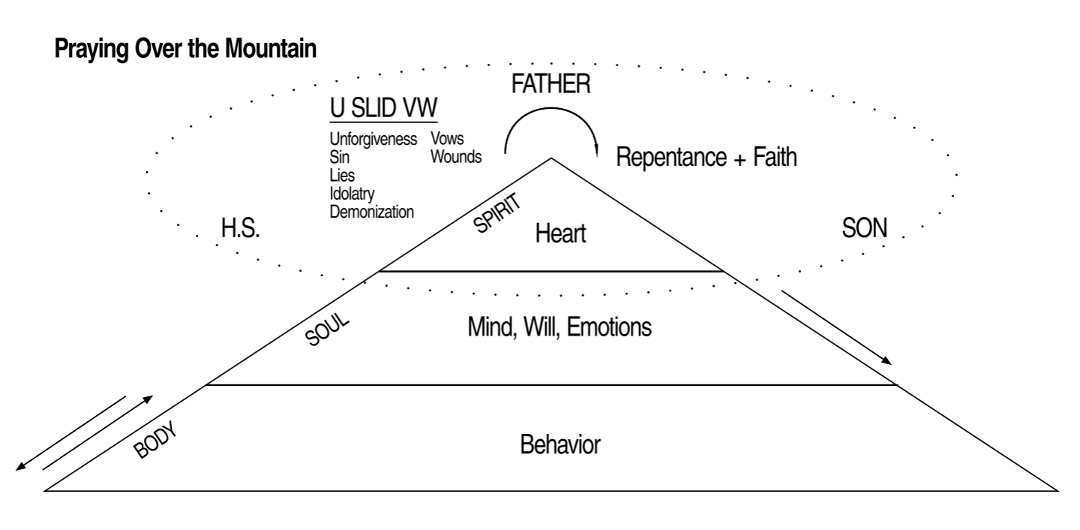
Transformational Prayer is a model of inner-healing prayer that helps a person move from surface-level behaviors down into the heart, where real change happens.
The Seven Issues of the Heart (U SLID VW)
U — Unforgiveness
(Matthew 18) Unresolved bitterness, offense, or anger toward someone becomes a spiritual barrier. Forgiveness breaks the chains that hold the heart in captivity.
S — Sin
(James 4:7–10; 1 John 1:5–2:1; Psalm 32; Psalm 5) Patterns of disobedience or rebellion create distance between us and God. Confession and repentance restore fellowship and peace.
L — Lies
(John 1:5; throughout Scripture) We often live out of lies we've believed about God, others, or ourselves. Healing involves asking the Spirit to reveal truth that replaces the lie.
I — Idolatry
(Jeremiah 17; 2 Kings 23) Idolatry occurs when we look to anything besides God for identity, safety, comfort, love, or control. These "false gods" shape the heart in destructive ways.
D — Demons
(Ephesians 6:10–13; Mark 3:15; Mark 6:13; Luke 10:7) Sometimes spiritual oppression is connected to unhealed wounds or unrepentant sin. The authority of Jesus brings freedom.
V — Vows
(Isaiah 30, 31) Inner vows ("I'll never trust again," "I'll always protect myself," etc.) become ungodly agreements that steer emotion and behavior. These need to be renounced.
W — Wounds
(Isaiah 53; Jeremiah 6:14) Past hurts—abuse, betrayal, neglect, trauma—leave emotional and spiritual wounds that Jesus desires to heal with His presence and compassion.
How U SLID VW Fits Into "Transformational Prayer"
- The Holy Spirit convicts, guides, reveals, teaches, and empowers during healing prayer.
- The Father speaks identity, love, pleasure, and place.
- Christ brings light, life, grace, truth, and healing.
As you pray "over the mountain," you partner with the Spirit to:
- Observe what is happening on the surface (behavior).
- Receive Revelation about the heart (what issue from U SLID VW is present).
- Experience Transformation as Jesus meets you with truth, freedom, and healing.
Repentance + faith create the bridge from the broken places in the heart to wholeness in Christ.
Seven False Sources of the Heart
(based on the patterns torn down in 2 Kings 23)
When Scripture describes Israel tearing down false gods, it isn't just about statues—it's about false sources of trust. These represent the inner places where the human heart looks for what only God can provide.
-
The Need for Protection or Control — A false refuge we run to when we feel vulnerable, powerless, or afraid. This is anything we use to guarantee outcomes, manage people, or feel "in charge" instead of surrendering to God's covering.
-
The Need for Prosperity — The belief that our flourishing, value, or future depends on our ability to produce or on something outside of God. This can look like striving, overwork, financial fear, or needing constant success to feel at peace.
-
The Need for Security — A drive to anchor ourselves in something predictable—finances, reputation, performance, relationships, or circumstances—so we don't feel exposed or unsafe. It's the longing to be untouchable or insulated from harm.
-
The Need for Safety or Relief — We turn to something that promises escape, numbness, or protection from pain. This shows up in avoidance, self-protection, addiction, or shutting down emotionally because it feels "safer."
-
The Need for Pleasure or Comfort — A desire to soothe the ache of the heart through something that feels good in the moment—attention, affection, food, entertainment, fantasy, or emotional highs. These things feel like they take the edge off, but they never actually heal.
-
The Need for Victory — The craving to be the one who wins, conquers, proves themselves, or never feels "less than." It's fueled by comparison, competition, anger, or the pressure to always come out on top.
-
The Need for Clarity or Identity — Looking to people, family expectations, roles, or achievements to tell us:
- who we are
- what we're worth
- what we're supposed to do
Rather than receiving identity from the Father.
How This Fits With U SLID VW
Each of these "false sources" connects directly to one of the heart-issues in the U SLID VW model:
- Idolatry → trusting something else to give what only God can give
- Lies → believing the false promise behind the idol
- Wounds → the place where the idol first felt necessary
- Vows → "I will never be vulnerable again," "I must take care of myself," etc.
- Sin → acting out of the idol
- Demons → spiritual footholds that attach to these patterns
- Unforgiveness → often the root wound that drove us to the idol in the first place
In prayer, when someone identifies the need rather than the idol name, it becomes far easier to uncover the deeper heart story and experience breakthrough.
Freedom
Used when an individual is experiencing intense spiritual oppression. Elders become involved and guide the person through confession, repentance, and releasing, helping them find freedom from spiritual oppression. Contact Carley Buckingham (cbuckingham@secc.org) to begin this process.
Listening Prayer
Coming soon.
Scripture Memorization
Coming soon.
Prayer Walking
Area-focused prayer is a strategic way to engage a neighborhood, region, or specific space where God is inviting targeted intercession. As intercessors, our role is to align our hearts with His, discerning His purposes and partnering with Him in prayer. This practice trains intercessors to pray with precision, spiritual insight, and authority, fostering both spiritual transformation and a deeper sensitivity to the Father's leading.
During these times, we are equipped to:
- Hear and agree with God's heart for the area.
- Identify and break strongholds or patterns the enemy has used to influence the space.
- Proclaim kingdom realities, advancing God's presence, peace, and purposes in the area.